Art Appreciation Online
-
Analyze and interpret works of art using discipline-specific vocabulary, identifying formal elements such as line, shape, space, composition, color relationships, material, and stylistic characteristics in written and visual formats.
-
Create original visual studies that replicate, reinterpret, or respond to historical artistic processes, documenting each stage of development through process images and written explanation.
-
Explain and visually demonstrate connections between historical image-making practices and contemporary visual media, including animation, motion graphics, and other forms of digital culture.
-
Critically assess and revise visual and written work for conceptual accuracy, formal clarity, and alignment with assignment criteria, incorporating instructor feedback and self-assessment strategies.
Module 1: Painting
In this module, students examine early image-making practices to understand how the earliest artists used line, surface, and environment to communicate. Through close study of prehistoric cave paintings and figurative forms, students will analyze how material limitations, environment, and mark-making strategies shaped visual expression.


Module 1: Exercise
In this exercise, students will create a “Primitive Palette” using household and natural materials to simulate early paint-making processes. The goal is to explore how artists historically worked within material limitations and how surface, binder, and pigment choices affect visual outcomes.
Students will document each stage of the experiment through process photographs and written explanations, reflecting on texture, color variation, adhesion, and mark-making potential.
LOs: 1, 2, 4


Module 1: Project
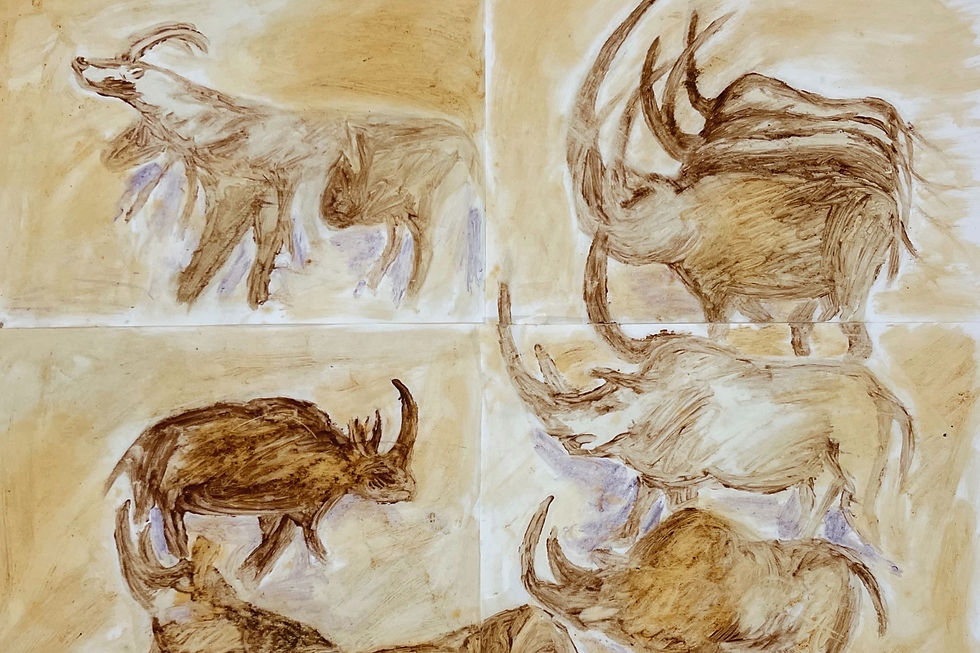
In this project, students will select a panel from the Chauvet Cave and recreate it using the primitive paint developed in the previous exercise. Working within the material constraints of their self-made pigments, students will closely observe line quality, animal structure, repetition, surface interaction, and implied movement present in the original composition.
The project emphasizes careful visual analysis before making. Students must study their selected panel, identify its formal characteristics, and intentionally apply those strategies in their recreation.
LOs: 1, 2, 3, 4
Module 1: Painting
In this module, students examine early image-making practices to understand how the earliest artists used line, surface, and environment to communicate. Through close study of prehistoric cave paintings and figurative forms, students will analyze how material limitations, environment, and mark-making strategies shaped visual expression.
Module 1: Project
In this project, students will select a panel from the Chauvet Cave and recreate it using the primitive paint developed in the previous exercise. Working within the material constraints of their self-made pigments, students will closely observe line quality, animal structure, repetition, surface interaction, and implied movement present in the original composition.
The project emphasizes careful visual analysis before making. Students must study their selected panel, identify its formal characteristics, and intentionally apply those strategies in their recreation.
LOs: 1, 2, 3, 4
A global survey of the cross-cultural evolution of art from the prehistoric period through the twentieth century. Emphasis will be placed on understanding the basic elements of art, the creative process, and the significance of art within the context of social, political, religious, and economic climate of its time.
Module 1: Exercise
In this exercise, students will create a “Primitive Palette” using household and natural materials to simulate early paint-making processes. The goal is to explore how artists historically worked within material limitations and how surface, binder, and pigment choices affect visual outcomes.
Students will document each stage of the experiment through process photographs and written explanations, reflecting on texture, color variation, adhesion, and mark-making potential.
LOs: 1, 2, 4